Showing posts with label Flowers. Show all posts

Friday, August 08, 2014

Summer Holiday in Cornwall

Cornwall has its own magic. Whether it’s the nostalgia of endless summer holidays, the ancient legends of King Arthur or the fabled light and skies that always attracted artists to St Ives,  there’s an air apart about Cornwall.

Driving down from Somerset, through Devon, all sleepy lush lanes, verdant hedgerows and trees, trees, trees, there’s a point when the rolling hills open up to brisk sea winds, when solitary wind turbines dot across the landscape and villages are built from stoic grey stone to withstand winter storms.

For some reason we never came west on childhood holidays in my family. Grandparents were in Edinburgh and Norfolk, and it was always north and east on day long car journeys, testing parents’ patience with the eternal refrain of ‘how many more miles?’ So heading there with  our combined families wasn’t a nostalgic return but rather a new discovery for my brother and I, taking our kids there for some bucket and spading and family togetherness.


We were near Polzeath in a big house with ample room for us all up on  a hill above the Camel estuary. There were several beaches within walking distance  (even for my three year old niece though she demanded a shoulder ride every now and then) and it was a wonderful novelty for our farm kids to be able to get about on foot.


I loved the lanes edged by dry stone walls overgrown with flowers, the contrast between the vivid green of the hills and lanes and the steely grey of the local slate, the layers of history that are present everywhere.


The big painterly skies are a common thread with South Africa, but here they were delicate cloudscapes, as the weather blew hot and cold on us, a rainstorm hurtling across the horizon at lunch time, brilliant sunshine for an evening walk.


And we had the kind of weather when you put extra clothes on to go to the beach, but go anyway, only the adventurous going right in for a swim, the rest paddling and defying the waves with sand fortifications and spades.


Another short diversion on the way to the beach at Daymer Bay on the River Camel estuary was to St Enodoc’s church with its appealingly crooked spire and green grassy churchyard.


Apparently it was almost buried by the sand dunes for a couple of centuries before being excavated again in the mid 19th century. There’s a John Betjeman poem about Trebetherick that about sums up the kids on holiday feel of this particular corner of Cornwall. http://www.johnbetjeman.com/trebetherick.html

Four nights was all too short, we could have spent another week or two there.

Girls at Polzeath beach more interested in observing stranded jelly fish than surfing.

The lane leading down to the beach at Daymer Bay
We stayed in Evergreen Lodge, which is perfect for two families or a group of friends - lots of space, big kitchen, long tables, big sofas and a nice enclosed garden. Hope we can go back there one day!

Friday, October 04, 2013

Our Spring Festival and A Rainbow

Every year at our spring festival one of the things we are thankful for is the winter rain, filling up our reservoirs, re-stocking the ground water and giving all our trees a chance to grow. This year there was an awful lot of rain to be thankful for, as it had hardly stopped raining between my rather rose-tinted winter in South Africa post back in August and the festival itself on the 21st September. It had rained solidly for several days before and sharp showers continued through the day. The long dirt road to reach our farm was waterlogged and pot-holed: passable, but I was already thinking about starting work building a boat of some sorts, even if not an ark just yet.

Once again I left all the cooking to the last minute, not even getting my meringues done the night before for the pavlova and having to do the shopping in the morning too, probably the least prepared I’ve ever been. But of course it all came together in the end, quiches and potato salad, joined by roast chickens, other salads and potato bakes brought by friends, and the meringue cooled down just in time for the cream and berries to go on top. There weren’t any elaborate water sculptures this year, most people arrived towards the end of the afternoon, so there was just time to make flower crowns,


decorate the archway,


for the younger boys (and dogs) to attempt an elaborate construction for the toboggan to go down.


and to create a river of light from candles in brown paper bags.


And with true serendipity there was a beautiful rainbow to bless the occasion.


Every festival has its own rhythm and I’ve gradually  learned to go with the flow, not stressing about timing and details – it always works out perfectly in its own way.


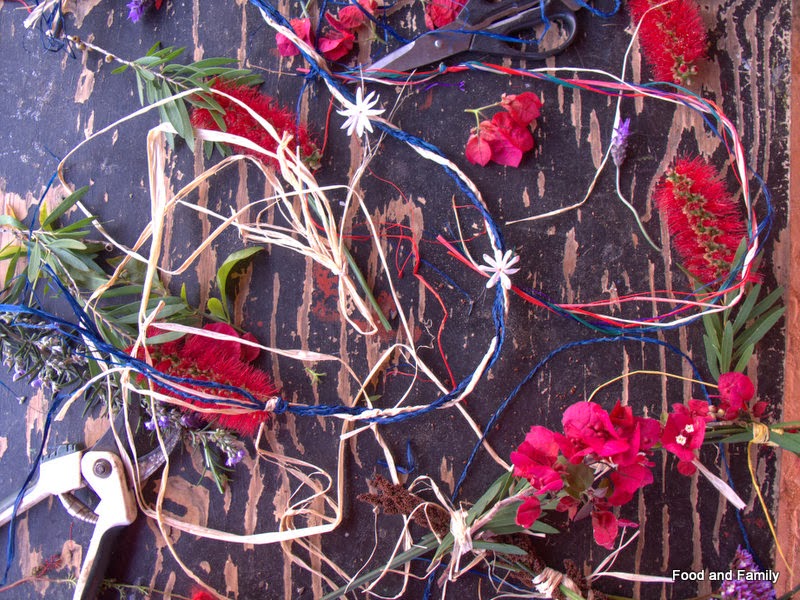
Our flower crowns have changed and evolved over the years. When the kids were little we used to make tissue and crepe paper flowers fixed on to card crowns. Then we plaited raffia and now most of the children's crowns are made with real flowers, plaited into the raffia, which is a painstaking and very individual process.


Then there is the arch to decorate with flowers - pincushion proteas, bougainvillea and cable ties.


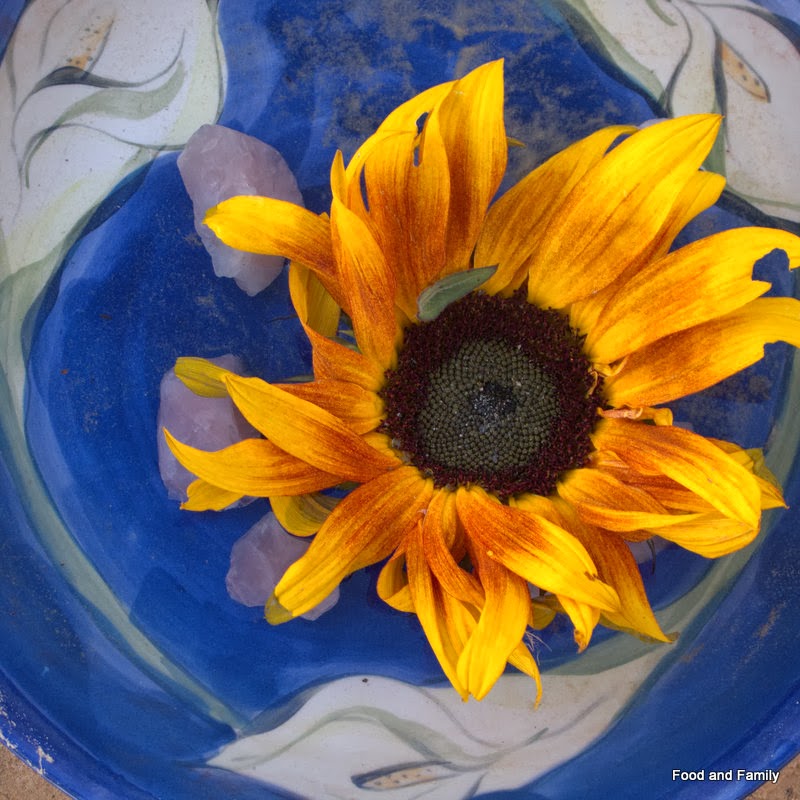
Because the theme is water, we have water bowls filled with flowers both in the circle and at the south end of the sand-pit. Amy thinks this is very convenient.


By the time we are all ready to carry our jugs of water and flower garlands into the circle the sun has set and it is dusk, but there is a glow in the sky still and a wonderful smell of fresh flowers and growing things in the air.


Blessings on the coming of spring!

More flowery spring festival posts for a little bit of nostalgia and seeing our kids growing up over all the years. 2006, 2007, 2010, 2011, 2012, and our blessing from 2006.

Friday, August 09, 2013

Winter

Winter in the Western Cape: at this time of year it seems like you blink and you’ve missed it. Having grown up with those long grey English winters which linger for endless months with depressingly short days, our South African winters are a joy.

There are rain storms and bunches of grey days for sure, but in between are those jewel-like days when the sun shines, you peel off your layers and bask outside in T-shirts. You’re almost sure of at least two days a week to get your laundry dry on the line, at least we are here, with a north-facing stoep sun-trap and a nice long line.

And yet you can be chillier here than ever I remember being in England. No central heating, and in these days of electricity price hikes, no electric heaters either. Just the one ceramic fireplace to warm the whole house. When the snow is on the mountains and the wind freezing cold despite the sunshine, we huddle in more layers than the Michelin man, with hats and gloves on inside, wrapped in blankets at the computer and on the sofa. But I don’t miss that central heating one bit.

And here we have flowers in winter.

Protea bush

September bush Polygala myrtifolia


First the tiny gems of oxalis poking their heads up from the sand. Then their cousins of the oxalis family, the longer stemmed citrus yellow sorrel, join in.


These are the ones that our kids used to pick in bunches outside their kindergarten, sucking the sour lemony stems after school, while their mothers chatted and lingered.

Glowing aloes are next, hot coal embers of orange and red. 


The golden shower isn't indigenous ( Pyrostegia ignea from South America)  but it adds a brilliant wall of orange ...


and the yellow daisy bush (Chrysanthemoides monilifera) adds the last dash of sunset to the palette.


The September bush (Polygala myrtifolia) seems to flower almost all year round but its hot pinks are just that bit of clashing colour needed to avoid getting all matchy matchy.

Finally the proteas bring some subtlety to the show with their sugary pinks and sculptural form.


And the bees have a ball all through winter, gathering nectar from aloes, protea and the golden shower, so that they make it through to spring in good shape.

I took all these pictures two weeks ago and already spring is snapping at the heels of winter, chasing it onwards with a snowfall of daisies, even while the snow on the far mountains keeps us from thinking winter is completely over.

I’ll have another cluster of flower pictures very soon, as all the early spring flowers are coming out in a rush now, even as the winter ones are still in mid song.

Friday, April 19, 2013

Grootbos Nature Reserve Part 2 - Fynbos and Philosophy

This is the second installment of our wonderful night away at Grootbos Private Nature Reserve. Read the first part here.

The view from our deck at dawn
Waking up in the morning to a dawn sky, soaking in the bath and watching colours change as the sun creeps over the hill behind us, listening to bird chatter in the fynbos, a magical start to the day at Grootbos
 
The bath tub with the best ever view
We’d planned two activities for the morning – if we’d been staying longer we would have just chosen one and had a lazy lie-in, but as it was we were at breakfast by 8 and spoilt for choice both with the buffet and the cooked to order hot breakfast.


There were cereals, muesli, yoghurt and bowls of seeds, nuts, raspberry and passionfruit puree as toppings, fruit salad, sliced fruits, cold meats and even smoked trout as well as fresh croissants and muffins. I went for a very decadent Eggs Benedict and then re-visited the buffet because I couldn’t resist the smoked trout and a croissant.


Grootbos is so much more than just a lovely five star retreat, though it does all that superbly well in a friendly and unpretentious style. I loved all the pampering, fantastic food and comfort, but it was the activities and the place itself that made the biggest impression. The nature  reserve grew out of the owner, Michael Lutzeyer’s, mission to conserve the beautiful fynbos eco-system of this region and their conservation programme has developed to an award-winning world class level. Not just that but the importance of enriching and giving back to the community here is actively recognised in two very successful social responsibility programmes.

The plant nursery at the Green Futures project

We were shown round both by Anecke, herself a graduate of the horticulture Green Futures training programme. Every year eight candidates are carefully selected from the two neighbouring communities of Stanford and Gansbaai and receive a very thorough grounding in both indigenous horticulture and basic life skills. As well as learning all about the fynbos plants and how to grow them, they learn computer skills, how to keep accounts, how to drive, language and interview skills. There is also an exchange link with the Eden Project in Cornwall UK, so every year three students get to travel there for three weeks and experience conservation  overseas.

The vegetable gardens at the Growing the Future programme

The second programme Growing the Future is aimed at local women between the ages of 18 and 35 and is a year course in growing organic vegetables and fruits. After three years this is becoming a self-sustaining initiative, growing produce to sell to the lodges, free-range chickens providing the eggs we’d just eaten for our breakfasts, bee-keeping producing delicious fynbos honey to sell in the shop and making preserves for the restaurants. Graduates from both programmes receive a nationally accredited certificate and can go on to do further training on site as guides or as lodge staff, or apply to do further horticultural training elsewhere. Many of them choose to work at Grootbos and the cheerful faces, confident and individual personalities of all the staff and guides we met are a testament to the success of the training.

Lavender for companion planting in the vegetable garden


We were whisked back to the lodge just in time to sally forth once more on our 4x4 fynbos safari with Jo, a wonderfully eccentric guide with a passion for her subject and a sprinkling of philosophy thrown in.


As we left the road and headed up a mountain trail she stopped to pick mysterious sprigs of restio, erica, protea and with hilarious deadpan anecdotes showed us so much more about how the natural fynbos eco-system works.


I’d never realised that the humble sour fig, which grows like crazy on our farm, is a vital refuge for small animals such as tortoises during fires. They can creep into its shelter and the succulent leaves protect them from the fire’s heat. I hadn’t known that restios are either male or female, that certain ericas need fire to reproduce: so many details shared in an entertaining and fascinating way. We also discovered the source of that elusive honey fynbos scent  that pervades the bush around the lodge – metalasia muricata, or its less than glamorous common name, the cauliflower bush.

Jo picking sprigs of metalasia muricata


Jo stopped the vehicle at a beautiful viewpoint for snacks, delicious home-baked cookies in four flavours, and while we were eating and chatting she wove all the plant samples picked on the way into a stunning bouquet, then turned wedding photographer to each couple in turn.


After this tour we were filled with even more respect  and admiration for how much Grootbos has done in the last 20 years to preserve, restore and protect the incredibly rich flora, gradually acquiring more land as neighbouring farms were sold, until they now have over 2000 hectares of pristine hill, milkwood forest and mountain.

The main lodge at sunset
Back at the lodge it was already lunch time, time for us to reluctantly leave, but we stayed long enough  to sample the lunch buffet, a fresh and flavoursome feast of salads with a choice of three hot mains to follow and even a dessert, though we were still too full from breakfast to make it all the way through the menu.

There were so many more activities that there just wasn’t time for in our short visit: horse riding trails through the fynbos, beach walks and picnics, a coastal cave tour, whale watching in the winter months, and of course the spa in the milkwood forest where there is no need of canned birdsong relaxation tapes, as the real thing wafts in through the open doors.

All in all I found Grootbos a thoroughly magical place to visit and the memories are sustaining me through a rather hectic week. If you get the opportunity, do not hesitate – go there and stay for as long as you can!

Fynbos bouquet

Note for my non-South African readers: fynbos is the name given to a particular type of vegetation mainly found in the southern tip of Africa. Low bushy green scrub is what it looks like to the eye, not a tree in sight. But when you look up close you find an enormous variety of different plants and flowers. Our guide, Jo, explained that to be identified as fynbos it should have four principal types of plants: proteas, ericas, restios and bulbinous plants. It’s an eco-system that supports many birds and small animals, but not a single giraffe or elephant! It's beautiful, fascinating and just as an essential item on any traveller's bucket list as the Big Five.


Disclosure: Our stay at Grootbos was complimentary, but I received no remuneration for writing this post and all opinions are my own.